Industry News
Essential Guidance for Choosing a China Used Tractor Trucks Supplier
The global logistics industry in 2026 faces intense pressure to increase efficiency while controlling operational costs. Cross-border transportation, particularly in developing regions, requires long-haul vehicles that can endure thousands of kilometers of continuous operation. In this high-stakes environment, procurement managers are increasingly looking toward the secondary market to optimize their capital expenditure. However, choosing a reliable China Used Tractor Trucks Supplier requires a shift in perspective from simple price comparison to a comprehensive evaluation of supply stability and residual value. A low initial purchase price can quickly vanish if a vehicle suffers from frequent downtime or lacks a clear maintenance history. Therefore, fleet operators must adopt a more sophisticated assessment framework when selecting a strategic partner to ensure their long-term fleet health and project profitability.

Evaluating Powertrain Transparency and Performance
The engine serves as the heart of any tractor truck, and its condition dictates the success of long-distance logistics. When evaluating potential suppliers, buyers should focus on the transparency of the powertrain's history and its suitability for specific geographical conditions. Modern Chinese tractors, such as the Howo T7H and the newer HOWO Max 6x4 models, have gained international recognition for their robust engineering. However, the performance of a used unit depends heavily on how the supplier has verified its mechanical integrity.
For instance, the Howo T7H series is known for its high-torque output, which is essential for hauling heavy containers across the varied terrains of Africa or Central Asia. Buyers should look for suppliers who provide detailed data on engine torque curves and fuel consumption metrics. In the high-frequency haulage markets of the Middle East, fuel economy becomes a decisive factor in maintaining thin profit margins. The HOWO Max series, which integrates advanced combustion technology, offers an excellent balance of power and efficiency. A professional supplier will conduct rigorous dynamometer testing to ensure these used units still meet their original performance parameters. This technical transparency allows fleet managers to predict operational costs accurately and avoid the hidden "fuel trap" of poorly maintained engines.
The Significance of Remanufacturing Standards
A critical distinction in the 2025-2026 market is the difference between a simple "repair" and professional "remanufacturing." Fleet managers in the Middle East have increasingly turned to remanufactured tractor heads, such as those from the SHACMAN series, as a viable alternative to new equipment. This trend is driven by the realization that a standardized remanufacturing process can eliminate the unpredictable risks associated with used machinery.
Professional remanufacturing involves a "part-level" overhaul. Technicians disassemble the entire engine block, clean every component using advanced industrial processes, and replace critical wear items—like pistons, liners, and bearings—with brand-new original parts. This process effectively resets the engine's lifecycle. For a SHACMAN tractor head operating in the extreme heat of the desert, this level of precision is not just a luxury; it is a necessity for preventing catastrophic failure. By choosing a supplier with a dedicated refurbishment capacity, such as a facility capable of processing 10,000 trucks annually, a buyer ensures that every vehicle in their order adheres to a consistent, high-quality standard.
Depth of the Global Service and Support Chain
The value of a tractor truck is realized on the road, not in the showroom. Therefore, an essential criterion for choosing a supplier is the depth of their international service chain. Logistics companies operating in 90 different countries under the "Belt and Road" initiative face unique challenges regarding spare parts availability. A supplier that merely ships a vehicle without supporting its lifecycle is not a strategic partner. Instead, fleet operators should verify if the supplier provides customized "maintenance packages" or "wear-part kits" that accompany the vehicle during export.
These kits should include essential items such as oil filters, air filters, and brake pads specifically matched to the truck model, whether it is a HOWO or a SHACMAN. Furthermore, the supplier’s experience in navigating the regulatory landscapes of countries like Tanzania, Saudi Arabia, or Uzbekistan is invaluable. Real-world delivery cases show that suppliers with high transaction volumes—processing over 70,000 transactions annually—possess the logistical expertise to handle complex customs clearances and technical documentation. This global reach ensures that if a technical issue arises in a remote region, the client has access to a response team that understands the local mechanical and legal context. This support network transforms a one-time purchase into a resilient operational asset.
Optimizing Asset Configuration through Large-Scale Inventory
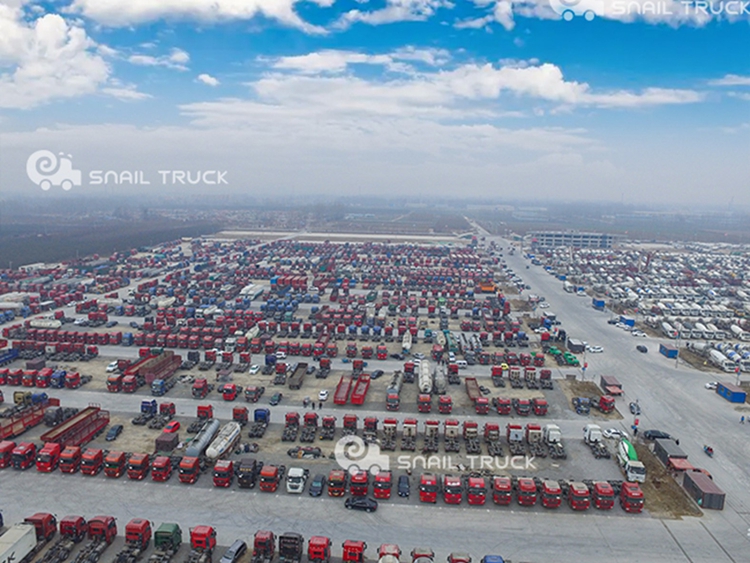
In the fast-moving logistics sector, the ability to deploy assets immediately is often the difference between winning and losing a contract. A major pain point for international buyers is the long lead time associated with procuring large fleets. A supplier with a massive, permanent inventory of over 15,000 trucks provides a "strategic buffer" that new vehicle manufacturers cannot offer. This scale allows a fleet manager to walk into a 1,000,000-square-meter base and select fifty identical units of the HOWO Max or T7H series to fulfill a new logistics contract instantly.
This immediate availability, valued at a transaction scale of 1,500 million USD annually, reflects a high level of market liquidity and trust. When a supplier maintains such a large stock, it also implies a standardized maintenance routine for all parked assets. Buyers benefit from this industrial approach because it ensures that every truck, regardless of its age, has been maintained under a unified protocol. For a logistics firm, this means they can achieve fleet uniformity without the years of waiting and high capital outlay required for brand-new equipment.
Positioning as a Technical Partner for Global Fleets
Choosing the right supplier for used tractor trucks is ultimately an exercise in risk management and strategic asset allocation. The successful procurer in 2026 looks beyond the paint job and focuses on the engineering truth underneath. By prioritizing powertrain transparency, national remanufacturing standards, and a robust global support chain, businesses can secure vehicles that perform like new at a fraction of the cost.
The Snail Truck has positioned itself as more than just a vendor; it serves as a technical partner for global logistics fleets. By bridging the gap between "used truck prices" and "new truck quality," the organization provides a pathway for companies in Africa, Southeast Asia, and beyond to scale their operations rapidly. The combination of a vast 1.5-million-unit-ready fleet and MIIT-certified technical precision solves the industry's most pressing anxiety: immediate delivery without a compromise on reliability. As global trade continues to expand, this model of professionally restored, strategically supported heavy machinery will remain the gold standard for international asset procurement.
For more information on the latest tractor truck inventory and remanufacturing standards, please visit: https://www.snail-truck.com/.
Categories
Latest News
Contact Us
Contact: Snailtruck
Email: snailtruck@snailtruck.com
Phone/Whatsapp: +86 18705477225
Add: NO.168 Quanpu Town, Liangshan County, Jining City, Shandong Province, China
 snailtruck